Installation
Plan a home charger installation that works for you
A good installation starts with the way you park and charge. Here is what to prepare, what the installer needs to assess and what to expect before you pay for the work.
From first enquiry to your first charge
- 1
Describe your parking and car
Tell the installer where you park, your exact car model and the charger you are considering. They may start with a photo survey, then arrange a visit.
- 2
Check the property
The installer assesses the route, electrical supply, existing equipment and other large loads. Photos help plan the job; they are not a reason to skip necessary checks.
- 3
Agree what is included
Get the charger position, cable route and work included in the price in writing. Agree how extra work, permissions or network-operator requirements will be handled before work starts.
- 4
Fit, test and hand over
The installer fits the equipment, carries out the required checks and commissioning, then shows you how to charge and gives you the relevant records and support details.
Photos and information to have ready
- The parking space with the car in its usual position
- The proposed charger wall or post and the distance to the car's charging inlet
- The likely route between the charger and existing electrical equipment
- The outside of the consumer unit and meter area, if safely accessible
- Details of solar panels, battery storage, electric heating or other large loads
Take only photos you can obtain safely. Do not remove electrical covers, touch terminals or move damaged equipment to get a better picture. Tell the installer if an area is inaccessible.
Check who owns the parking space and wall before ordering work. Tell the installer about rented property, shared land or a listed building early.
For a fuller walkthrough, read what a home charger installation involves. If the charger will be in a detached garage, see planning a long cable run. Renters and flat owners can check the current grant guide before booking.
Choose the position and cable route together
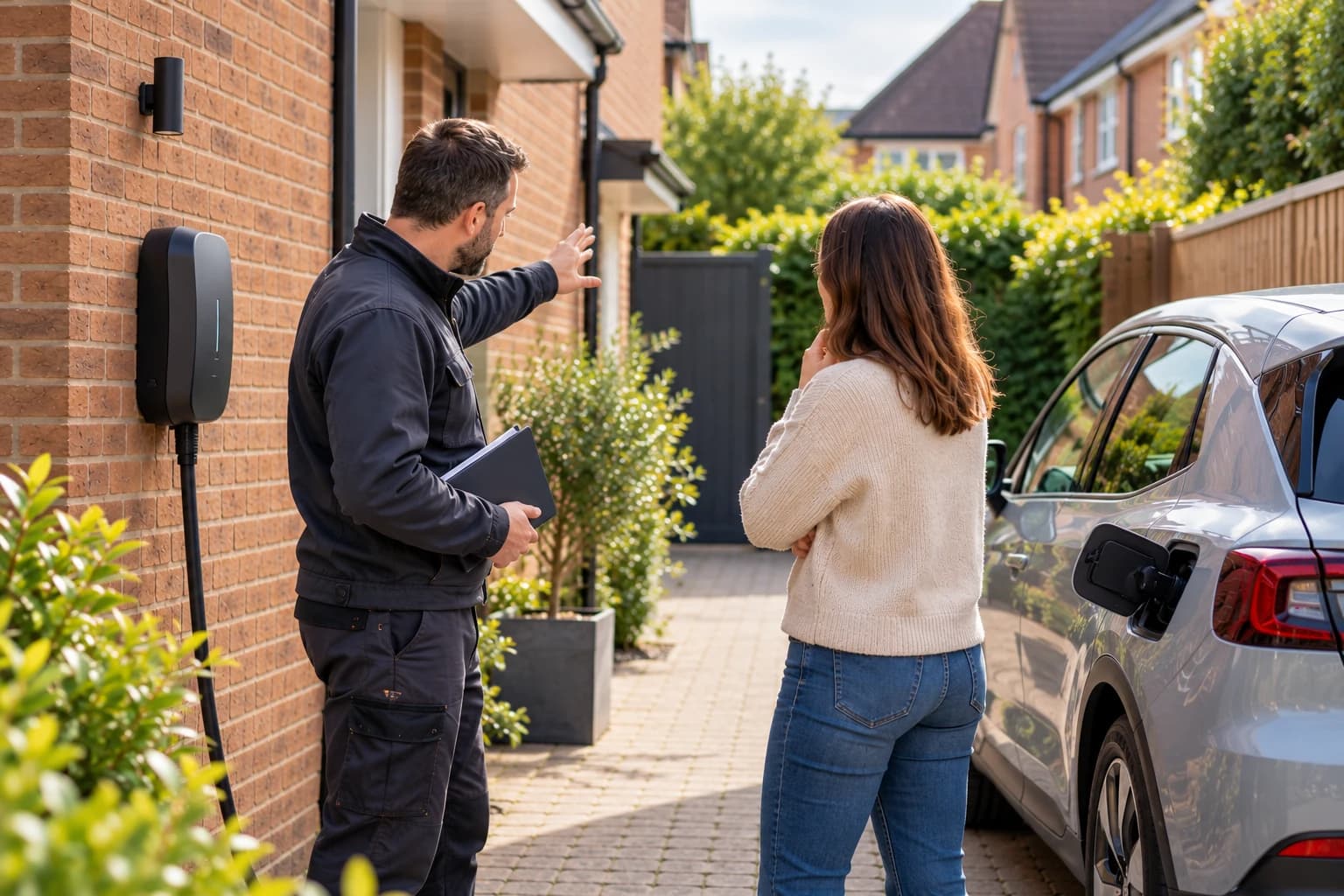
Where will you actually plug in?
Park normally and check where the car's inlet sits. The lead should reach without tension, crossing a regular walking route or blocking a gate. Consider whether you reverse in, use two cars or may change vehicles.
Agree a usable height and position with the installer, following the charger's mounting instructions. Think about access, lighting and where an attached or separate cable will be stored. Compare cable and socket arrangements before choosing a model.
How will the supply cable get there?
A short visible route may be simpler than running through several rooms, under paving or around a detached garage. Ask which walls will be drilled, whether digging is needed and who makes good afterwards.
The electrical supply cable and the lead from charger to car are different things. Leave cable sizing, protection and the final installation design to the installer; there is no universal cable size for every house.
What the electrical survey is for
Consumer unit and supply capacity
A spare space in the consumer unit is not proof that a charger can be added without other work. Its condition, the available supply, earthing arrangements and protective equipment need assessment.
Ask why a board change, fixed charging limit or supply work is being proposed. Your car's AC limit also matters: a higher-rated wall unit does not necessarily make charging faster. Read consumer units and home charging and 7 kW versus 22 kW.
Load balancing, in everyday language
A compatible load-balancing system can turn charging down while other appliances use more of the available power, then increase it again when there is room. It shares capacity; it does not create extra capacity.
Ask whether the chosen charger supports it, what monitoring is needed and whether it is included in the quote. Correct setup matters. The load-balancing guide explains the distinction from a fixed power limit.
What usually happens on installation day
The installer confirms the agreed position and route before fitting the equipment and its supply circuit. Arrange clear access and ask about any planned interruption to household power.
After the physical work come electrical checks, commissioning and a charging demonstration. Have the car available where possible, along with your phone and any app/account information the charger needs. Enter your own account and network credentials during setup rather than sharing them unnecessarily.
Ask the installer to demonstrate the normal indicators, starting/stopping a session and the agreed scheduling or power settings. The duration depends on the property and scope, so confirm the appointment expectations rather than assuming every job takes the same time.
See the installation-day guide for a practical appointment and handover checklist.
What can make the job more involved?
Distance and access
Long routes, trenching, paving, wall penetrations or a detached garage can add work and making good.
Existing electrical issues
Supply limitations or equipment needing remedial work may need resolving before the charger is connected.
Shared or rented property
Parking ownership, landlord/freeholder permission and shared electrical supplies can change the scope.
Other energy equipment
Solar, storage, electric heating or multiple EVs need considering together rather than separately.
Check that each quote covers the same work, rather than comparing headline prices alone. Use the installation cost guide to check what is left out and what could change the price.
Network involvement and parking without a driveway
Who is the DNO?
The distribution network operator runs the local electricity network. It is different from the energy supplier that sets your tariff and sends the bill.
The installer should explain the applicable notification or approval process. If the assessment identifies capacity constraints or network work, agree who contacts the operator and whether anything must happen before installation. Processes differ by network area and UK nation; do not assume every home needs an upgrade.
No private driveway?
Start with parking rights, property consent and a realistic route. Allocated bays, communal parking and council-approved pavement solutions involve different permissions and arrangements.
Do not improvise a loose charging cable across a public pavement. An authorised channel may be possible in some areas, but it does not reserve the parking space for your car. Read charging without a driveway before paying for equipment.
Ask useful questions—and leave with a working charger
Before accepting the quote
- What position and cable route does the price assume?
- Which extras could change the price after the survey?
- Why is any supply or consumer-unit work needed?
- Is load balancing included, and how will it be set up?
- Who handles permissions, network notifications and any approvals?
- What testing, certification and making good are included?
At handover
- A demonstration of starting, stopping and scheduling a charge.
- The model/serial details, operating instructions and agreed settings.
- Ownership of your app/account and a clear explanation of any subscriptions.
- The applicable electrical test/certification and completion paperwork for your installation and UK nation.
- Warranty conditions and the installer/manufacturer support contacts.
- An explanation of what to do if warning indicators appear.
Further reading
Sources
- Last reviewed
- Electric vehicles: cost, time and what's involved — UK Power Networks. Supply assessment, installer notification and site-specific network work. UK Power Networks' process applies in its own service area; other operators have their own arrangements.
- How to register energy devices in homes or small businesses — Department for Energy Security and Net Zero, GOV.UK. Great Britain guidance on network registration, installer responsibilities and documentation. Check current OZEV guidance for grant eligibility.
- Electrical safety advice for electric vehicles — Electrical Safety First. Dedicated charging equipment, competent installation and stopping use of damaged charging cables.
- The critical role of Grid CT sensors in myenergi installations — myenergi. Manufacturer-specific explanation of supply monitoring, Grid Limit settings and charger load curtailment; not a universal specification for other brands.
Network processes are location-specific. UK Power Networks guidance applies in its service area; the GOV.UK registration guidance covers Great Britain. Your installer should confirm the arrangements for your property.