Skip to content
EV Charger HelpHome charging help
Menu

Guide

Home EV charger installation: survey to handover

An installer checks your supply, runs a dedicated cable from your consumer unit, fits the charger, notifies your network operator and hands you certificates. Most homes need no work on the incoming supply. The main thing people are surprised by is how much the price depends on the distance the cable has to travel.

Before anyone visits

What to sort out before the survey

Several of these are conditions of getting a grant, not just good practice.

Installation is a straightforward job for a competent electrician, but the steps before it are where projects go wrong. In particular, doing the work in the wrong order can make you ineligible for money that would otherwise have paid part of it.

A few other things to settle first. If you rent your home, you need written permission from your landlord, freeholder or property manager, and you will usually need to provide it as part of a grant application. If you live in a flat, the permissions can involve more than one party, so allow time.

Decide where the charger will go, roughly, and where the car will sit. Both matter for the price and both are hard to change afterwards. Finally, get more than one quote, and check that the installer is authorised if you intend to claim a grant.

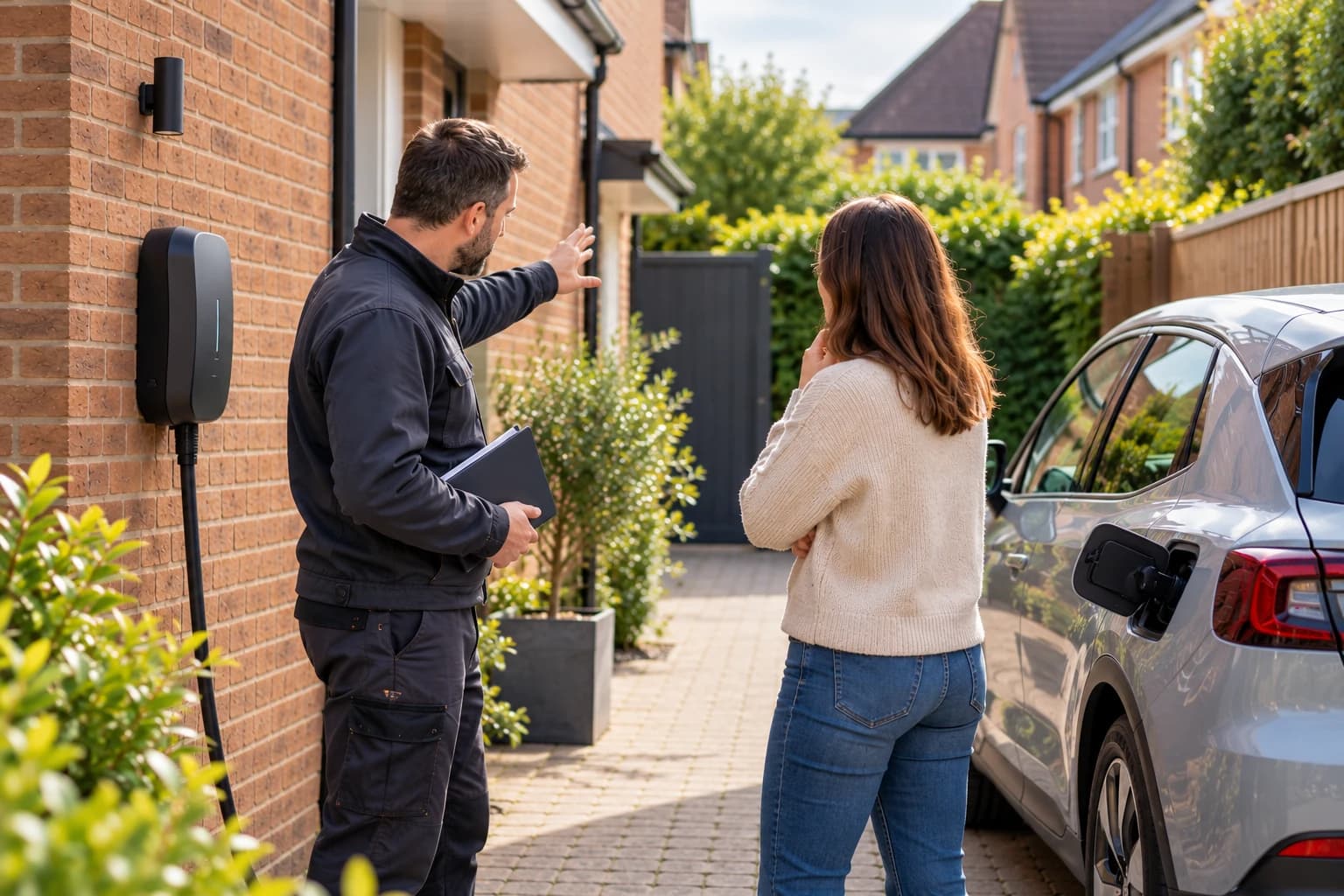
Installer and homeowner discussing the charger location beside a parked car.

What is involved

The stages, in order

Here is roughly how a straightforward home installation runs. The order matters because the survey sets the price and the price commits you.

  1. 01

    Before

    Sort out permission and quotes first

    If you rent, you need written permission from your landlord or freeholder. If you intend to claim a government grant, you must apply and be confirmed eligible before any work starts. Get quotes from authorised installers, not just the cheapest.

  2. 02

    The survey

    Someone checks your supply

    Usually remotely, sometimes on site. They establish whether your consumer unit can take a new circuit, how the supply is arranged, how much demand the property already has, and how the cable would reach the car. This is where the price becomes real.

  3. 03

    The work

    A dedicated circuit from the consumer unit

    The charger is wired back to your consumer unit, the box with the fuses, on a circuit of its own rather than sharing an existing one. Protective devices are fitted, the cable is run and terminated, and the unit is mounted where you agreed.

  4. 04

    The paperwork

    You get certificates and confirmations

    An electrical installation certificate for the work, a certificate covering building regulations, and written confirmation that the network operator has been notified. Keep all of them; they matter for your home and for selling it.

  5. 05

    After

    The installer makes the grant claim

    If you are claiming a grant, the authorised installer submits the claim and the money is paid to them, reducing the amount you owe. You should see the reduced figure on your invoice.

Why the charge goes on its own circuit

A home chargepoint draws a large current for a long time. Sharing a circuit with something else would mean both are affected when that circuit is loaded, and the protective devices would be selected for a load that never actually occurs. A dedicated circuit from the consumer unit avoids that, and it is why installation involves your fuse box rather than just the wall where the charger goes.

Notifying the network operator

The company that brings electricity to your property is called your distribution network operator, or DNO. Adding a chargepoint is a change to what your connection draws, and these changes are notified. Guidance from OZEV describes two routes: an installer can install and then notify the DNO within 28 days, or they must apply to the DNO before installing, depending on the size of the equipment and what is already connected at the property.

Which route applies is decided by the installer as part of the survey. It is also your responsibility to make sure the DNO has been notified, so ask for written confirmation that it has been. OZEV requires authorised installers to notify the DNO in writing, and failure to do so can put their authorisation at risk.

Paperwork

What you should be handed on the day

Ask for these before the installer leaves. They are not optional extras.

Several documents come out of a compliant installation. You should expect all of them, and if something is missing, ask before paying.

  • An electrical installation certificate for the circuit covering the new work. OZEV requires authorised installers to issue a BS 7671 electrical installation certificate to the customer, and the grant cannot be claimed without it.
  • A certificate covering building regulations. An installer registered with a competent person scheme registers the work with them and gives you the certificate. One that is not registered has to submit a building notice to the local authority before starting, and the certificate then comes from the council. In Scotland the equivalent step runs through the local authority building standards service, which may involve a building warrant.
  • Written confirmation the DNO was notified, and the reference or date for it.
  • The charger's own documents, including its warranty, its app details and its stated electrical ratings.
  • The final invoice showing the grant deduction if you are claiming one, since the money goes to the installer rather than to you.

Installation also has to comply with recognised standards, which OZEV lists for grant purposes: BS EN 61851, the IET wiring regulations BS 7671, the IET code of practice for electric vehicle charging equipment installations, and the Electricity Safety, Quality and Continuity Regulations, alongside the relevant building regulations. You do not need to know these, but it is reasonable to ask whether the work is being done to the current standards and which edition.

What changes the price

Why two quotes for the same charger differ

Almost all of the difference comes from the property, not the product.

The charger itself is the smaller half of most invoices. These are the things that move the number, and they are worth asking about in every quote.

Distance

How far the cable has to run

Cable length is the single biggest variable cost in most quotes. A long run from the consumer unit to the far side of a driveway needs more cable, more labour, and possibly different protective devices. A post-mounted unit partway along the route can cost less than one at the house wall.

Groundwork

Whether digging is needed

A cable crossing a lawn or a driveway needs to be buried properly, which adds excavation, reinstatement and possibly a notice to the network operator if the route crosses or runs near their equipment. Ask whether the quote includes reinstatement.

The consumer unit

Work on your fuse box

Some installs need an extra protective device, and some need the consumer unit itself replaced or upgraded. A survey should establish this, but a quote that does not mention it is worth questioning.

Earthing

How your property is earthed

The earthing arrangement at the property affects what protective equipment the circuit needs. This is a technical detail, but it is one of the reasons two quotes for the same charger can differ.

Which installer

Whether they self-certify

An installer registered with a competent person scheme can usually certify the work themselves. One that is not has to submit a building notice to the local authority, which adds a step and can add cost and delay.

This is also why a site survey is worth having before you commit. The same charger can differ in cost substantially between two homes that look identical from the outside.

What this means for you

Before you book your installation

If you are applying for a grant, get eligibility approval first. Then get more than one itemised quote and read the survey findings before agreeing to a price.

  • If a grant is available to you, do not allow installation to begin until you have the eligibility notification. The rule is absolute, and the money is lost permanently if you get it wrong.
  • Measure how far the charger is from your consumer unit before the survey. It is the single biggest driver of the price and it is trivial to establish.
  • Ask each installer the same questions, particularly about the certificate, the network notification and what happens if the survey finds something unexpected. This helps you see which quote covers the work you need.
  • Keep the certification and the grant paperwork. They are what a landlord, a buyer or an insurer will ask for later.

If you have not chosen a charger yet, how to choose a home EV charger sets out the sequence that avoids paying for speed you cannot use. The connector is rarely the deciding factor, which is explained in what a Type 2 connector is.

Further reading

Sources

Last reviewed

We use optional Google Analytics cookies to understand which pages and tools people use. Analytics stays off unless you accept. Declining will not affect how the site works.

Your choice is saved for six months. You can change it using “Analytics cookies”. Google receives usage information only after you accept; we do not send your calculator entries, names or email addresses. Google's privacy policy.