Guide
Does an EV charger need its own consumer unit?
Not automatically. A dedicated charging circuit and a separate consumer unit are different things. The charger may be supplied through suitable existing equipment or a separate arrangement, but an electrician must assess the installation and the charger instructions before deciding.
In plain English
Understand the box and the circuit
The consumer unit is the household distribution box containing switches and circuit protection. People often call it the fuse box, even where the protective devices are circuit-breakers. A circuit is an electrical path supplying particular equipment. Adding a circuit does not necessarily mean adding another distribution box.
The IET describes dedicated Mode 3 charging as a circuit supplying charging equipment with control and monitoring. For a home wall charger, that is different from treating the unit like another appliance on an existing general-purpose socket circuit.
A proposal might add a suitable circuit to the existing consumer unit, add a separate small unit, or include other alterations. The important question is why that arrangement suits the property. The presence of a second box is not, by itself, evidence that the installation is safer or faster.
In plain English
A spare space is only the beginning of the check
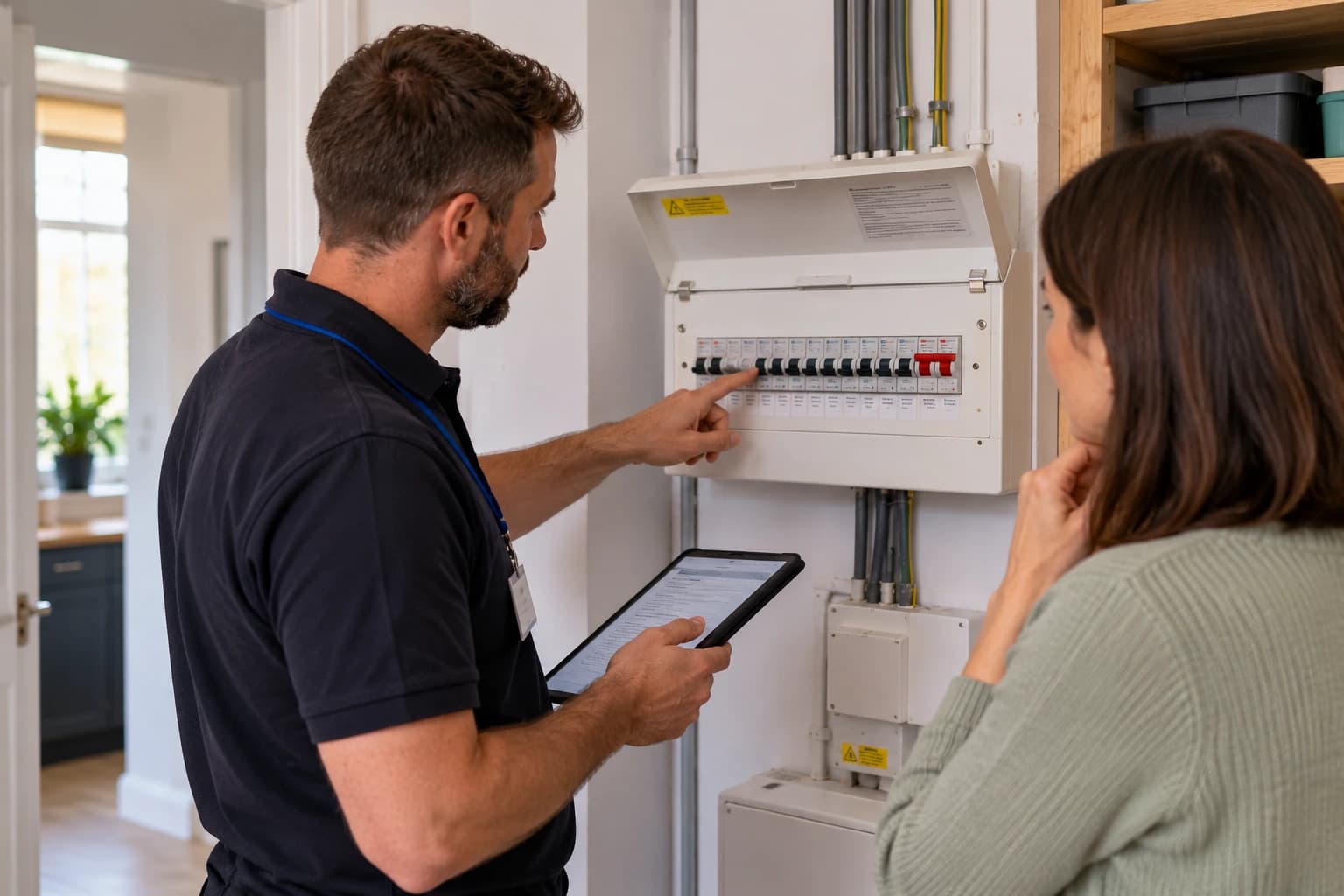
An empty-looking slot does not prove that the existing unit can accept the proposed circuit. The installer needs to assess its condition, suitable compatible devices, the existing installation and the requirements of the chosen charger. That is more than checking whether another switch physically fits.
Explain other major electrical loads and planned changes, such as a heat pump or another car. A main fuse marked 60 A, 80 A or 100 A is only one part of the picture; that number alone does not decide whether a charger can be added. The electrician needs to assess the incoming supply, wiring, existing demand and proposed charger together. UK Power Networks says an installer should check whether the charger can be connected directly or supply work is needed first; its process applies in its own service area.
No spare space in the consumer unit? That does not automatically mean the whole unit must be replaced. An electrician can assess whether a suitable design can use the existing unit or needs an additional unit or other work. There is no single fuse rating or spare-space rule that decides the answer for every home.
Do not remove the cover to photograph internal wiring or read device labels. Give the installer safe external photographs if requested and let them make the assessment. The survey should establish the design, not turn into a remote shopping list based on what you can see.
In plain English
Protection depends on the complete arrangement
A circuit-breaker deals with excessive current, while a residual current device, or RCD, responds to certain current imbalances that can indicate leakage. Devices may combine functions. The selection and coordination of those devices with the charger and wiring need electrical design.
The IET explains several options for EV-related residual-current detection and protection. A feature inside the charger does not automatically settle everything required upstream. Equally, two products with different internal protection may lead to different installation proposals without either being wrong simply because they differ.
Ask which functions the proposed equipment provides and what remains part of the fixed installation. Do not choose a breaker rating from the charger headline power, bypass a device that trips, or assume that a larger rating is an upgrade. This guide cannot specify protection for an unseen property.
In plain English
Why an installer might propose a separate unit
A separate arrangement may be proposed because of the existing equipment, a practical cable route or how the charger circuit is to be protected and isolated. The installer should explain the reason in terms of this property, rather than saying every EV charger needs an identical extra box.
It does not create extra supply capacity. If the house and car draw more than the assessed allowance, adding another consumer unit does not make that demand disappear. Load balancing and any network work are separate parts of the decision.
Also ask which equipment will be isolated during maintenance and how the arrangement will be labelled. A future electrician should be able to understand it from the documentation. The IET distinguishes protective devices from isolation and switching functions; a charger app is not a substitute for an appropriate electrical arrangement.
In plain English
Ask why the work is needed
If one installer proposes a new unit and another does not, ask both to explain why. They may have assessed different charger versions, cable routes or existing conditions. Compare all the work included in their written quotes, rather than judging them only by whether a new unit is listed.
Request separate explanations for necessary EV work and unrelated improvements. Ask what happens if testing identifies an existing problem, and agree how additional work would be authorised. There is no universal replacement age or fixed price that this article can apply to your consumer unit.
For the broader budget, use the installation-cost guide. Electrical Safety First recommends competent, registered installation. Qualifications, a clear scope and the completed checks matter more than treating the quote as a contest to buy the fewest components.
Your next step
What this means for you
- Ask whether the proposal is a new circuit, an additional unit or replacement of existing equipment.
- Ask why that arrangement is suitable for your charger and property.
- Keep supply-capacity questions separate from space in the box.
- Confirm testing, labelling and the documentation you will receive.
- Do not alter circuit protection or commissioned limits yourself.
Our installation-day walkthrough covers the demonstration and handover. Leave with a clear explanation of the finished system, including whom to contact if it faults. For a supply-rating question, also see single-phase versus three-phase or ask for a home installation survey.
Further reading
Sources
- Last reviewed
- Protective, isolation and switching devices explained — Institution of Engineering and Technology, Wiring Matters, July 2026. Dedicated Mode 3 charging circuits, different protective-device functions and the need for installation-specific selection. Not a universal consumer-unit or breaker specification.
- Electrical safety advice for electric vehicles — Electrical Safety First. Dedicated charging equipment, competent installation and stopping use of damaged charging cables.
- Electric vehicles: cost, time and what's involved — UK Power Networks. Supply assessment, installer notification and site-specific network work. UK Power Networks' process applies in its own service area; other operators have their own arrangements.
- How to register energy devices in homes or small businesses — Department for Energy Security and Net Zero, GOV.UK. Great Britain guidance on network registration, installer responsibilities and documentation. Check current OZEV guidance for grant eligibility.