Guide
EV charger installation day: what to expect
The installer confirms the agreed location and route, carries out the electrical work, tests the installation and sets up the charger. Before leaving, they should explain how to use it and what documentation you will receive. The time and exact work depend on the survey, so there is no universal 'finished in a morning' promise.
In plain English
Make the appointment easier before anyone arrives
Clear safe access to the agreed work areas, including the consumer unit, meter area, route and parking space. Move stored items rather than expecting the electrician to work around them. Keep children and pets away from the working area and agree where the car should be parked.
Have the quote, survey details and exact charger version available. If the installer plans to demonstrate charging, ask whether the car and any separate cable need to be present. Have access to your home Wi-Fi details and any required account, but do not share passwords more widely than necessary.
Ask in advance about any planned power interruption. Explain equipment or circumstances that make a loss of power difficult and agree a suitable plan. Do not assume the appointment can proceed exactly as quoted if access, the cable route or the household equipment has changed since the survey.
In plain English
Walk through the location and route together
Before drilling starts, confirm where the charger will sit and how its cable will reach your car’s charging port in your normal parking position. Think about opening doors, walking past the car and storing the cable when it is not in use.
Confirm the route through or around the house, any groundwork and what the finished surfaces should look like. If a different route is proposed, ask whether it changes the price, access permissions or reinstatement. A quick conversation at this point is easier than discovering afterwards that you pictured a different installation.
The wider survey, permissions and network planning belong before the appointment. Our installation-planning guide covers those stages. This walkthrough focuses on the visit and handover once the necessary arrangements are in place.
In plain English
Leave the electrical work to the installer
The work typically includes mounting the unit, running and terminating the cable and arranging the circuit and protection specified for the installation. The exact equipment is a design decision, not a list that every house must buy unchanged.
Electrical Safety First recommends a registered, competent electrician trained for EV chargepoint installation. Do not help by opening the charger, moving supply wiring or removing sealed equipment. If the installer finds something the survey did not reveal, ask for an explanation of the revised scope before agreeing to additional work.
Supply work involving the DNO may be a separate appointment. UK Power Networks explains that an installer may need network assistance before connecting the charger. Other operators have their own arrangements. The charger being physically mounted does not mean an unresolved supply requirement can be ignored.
In plain English
Testing and setup are part of the finished job
Commissioning means checking the installed system and putting it into service with appropriate settings. It is more than confirming that the charger lights up. Ask what tests have been completed, which power limit was set and whether any load-monitoring equipment has been checked.
For a smart charger, check account access, the app and any connection to a tariff service. Agree which system controls the schedule if both the car and charger have timers. Do not leave with a demonstration that works only through the installer’s own account.
Covered private smart chargepoints in Great Britain have default off-peak settings and a randomised-delay function under the government’s guidance. Ask the installer to explain the displayed waiting states, how to change a normal user schedule and how to request charging when needed. That is different from altering a commissioned electrical limit.
In plain English
Ask for a demonstration and a clear document trail
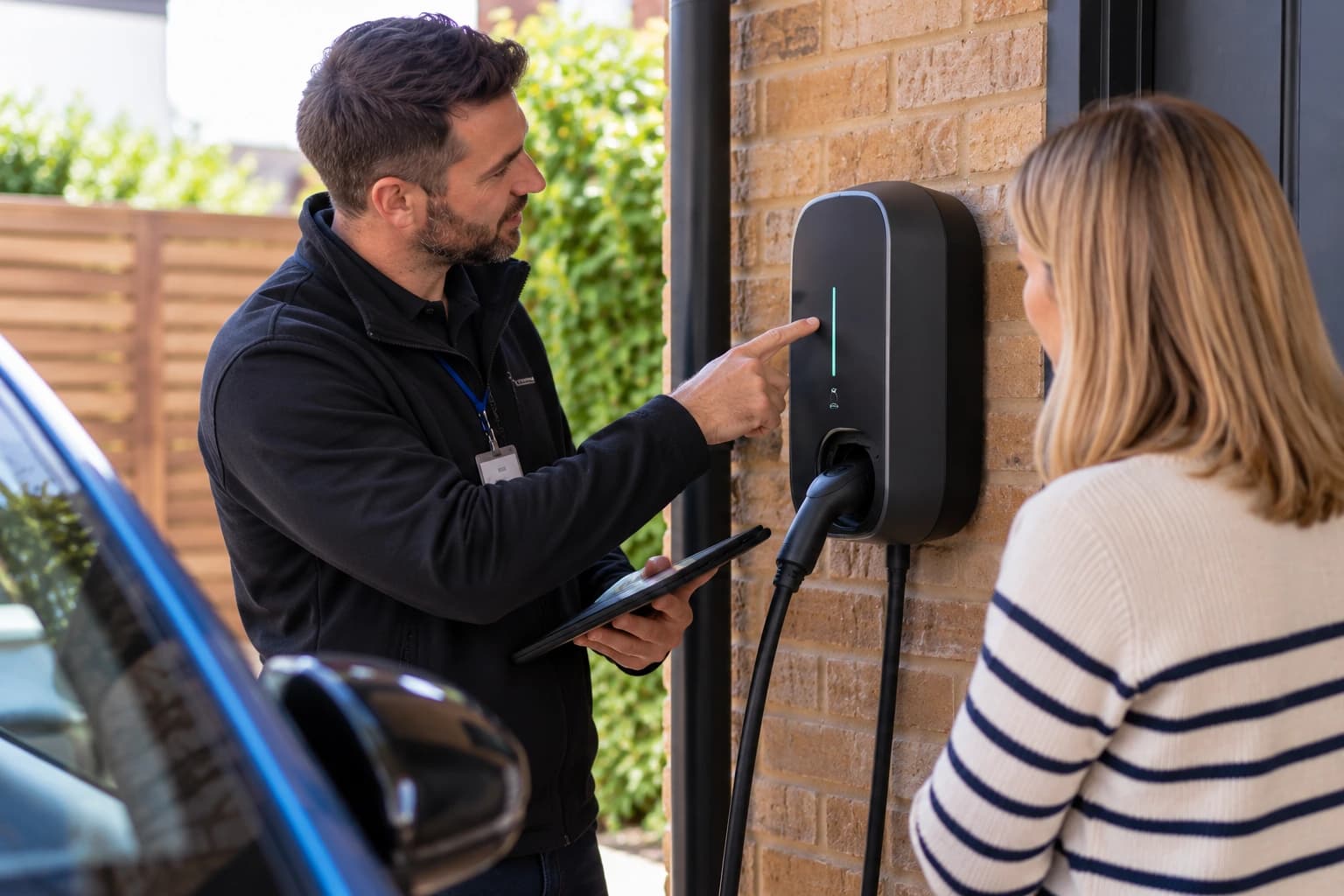
Where the car is available, ask to see a session start and stop. Confirm which indication means charging, which means waiting, and how to disconnect and store the cable using the manufacturer’s instructions. A first session need not reach the unit’s headline power if the car or supply has a lower limit.
Keep the product manual, account details, model and serial number, warranty information and the electrical installation documentation. Ask what certificate or building-regulation documentation applies to your location and work, who issues it and when it will arrive. GOV.UK’s registration guidance distinguishes different building-control arrangements in Great Britain.
Also ask who handled the network application or notification and how you can retain confirmation. For a grant-supported job, check the invoice and outstanding claim steps against the current scheme. OZEV’s household guidance requires eligibility notification before relevant grant installations; a completed appointment cannot retrospectively fix a missed approval.
Your next step
What this means before the installer leaves
- Can I start and stop a charge using my own account?
- Do I know the charging limit and which system controls the schedule?
- Have load balancing or solar settings been explained, if fitted?
- Do I know which documents have arrived and which will follow?
- Who do I contact about an electrical issue, an app issue or a warranty claim?
Register the charger with the manufacturer where appropriate so safety or recall information can reach you. Save the setup details with the invoice rather than relying on a disappearing message thread.
If the first sessions seem different from the demonstration, record the settings and status messages. Our slow-charging checklist helps distinguish an ordinary limit from a problem that needs support.
Further reading
Sources
- Last reviewed
- Electrical safety advice for electric vehicles — Electrical Safety First. Dedicated charging equipment, competent installation and stopping use of damaged charging cables.
- Electric vehicles: cost, time and what's involved — UK Power Networks. Supply assessment, installer notification and site-specific network work. UK Power Networks' process applies in its own service area; other operators have their own arrangements.
- How to register energy devices in homes or small businesses — Department for Energy Security and Net Zero, GOV.UK. Great Britain guidance on network registration, installer responsibilities and documentation. Check current OZEV guidance for grant eligibility.
- Regulations: electric vehicle smart charge points — GOV.UK / Office for Product Safety and Standards. Great Britain rules for covered private chargepoints, including default off-peak settings, randomised delay and continued charging without a communications connection.
- Changes to chargepoint grant schemes from 1 April 2026 — Office for Zero Emission Vehicles, GOV.UK. Current schemes, maximum awards and the requirement to await eligibility notification before installation where claiming the specified household grants.