Guide
How much does it cost to install a home EV charger?
There is no single reliable price for every UK home. Your budget needs to cover the charger, the work at your property and any separate network or permission costs. A survey-backed, itemised total is more useful than an advertised 'from' price for a standard installation.
In plain English
First establish what the price includes
Charger-only prices and installed-package prices are different things. The hardware price may exclude fitting, monitoring accessories or an extra cable. An installation package may include only a stated cable length and an uncomplicated route. Read its definition of “standard”, not just the large price at the top.
For one dated hardware example, myenergi’s zappi page advertised a starting price of £779, including VAT if applicable, when checked on 1 October 2026. That is a manufacturer’s advertised starting point for its product, not an average UK installation cost, a recommendation or a quote for your property.
Ask every installer for the amount you would actually pay, including applicable VAT and required accessories. If a grant is deducted, request the undiscounted total and the grant separately. That makes competing proposals easier to compare and avoids confusing a subsidy with a cheaper installation.
In plain English
The route and electrical assessment shape the job
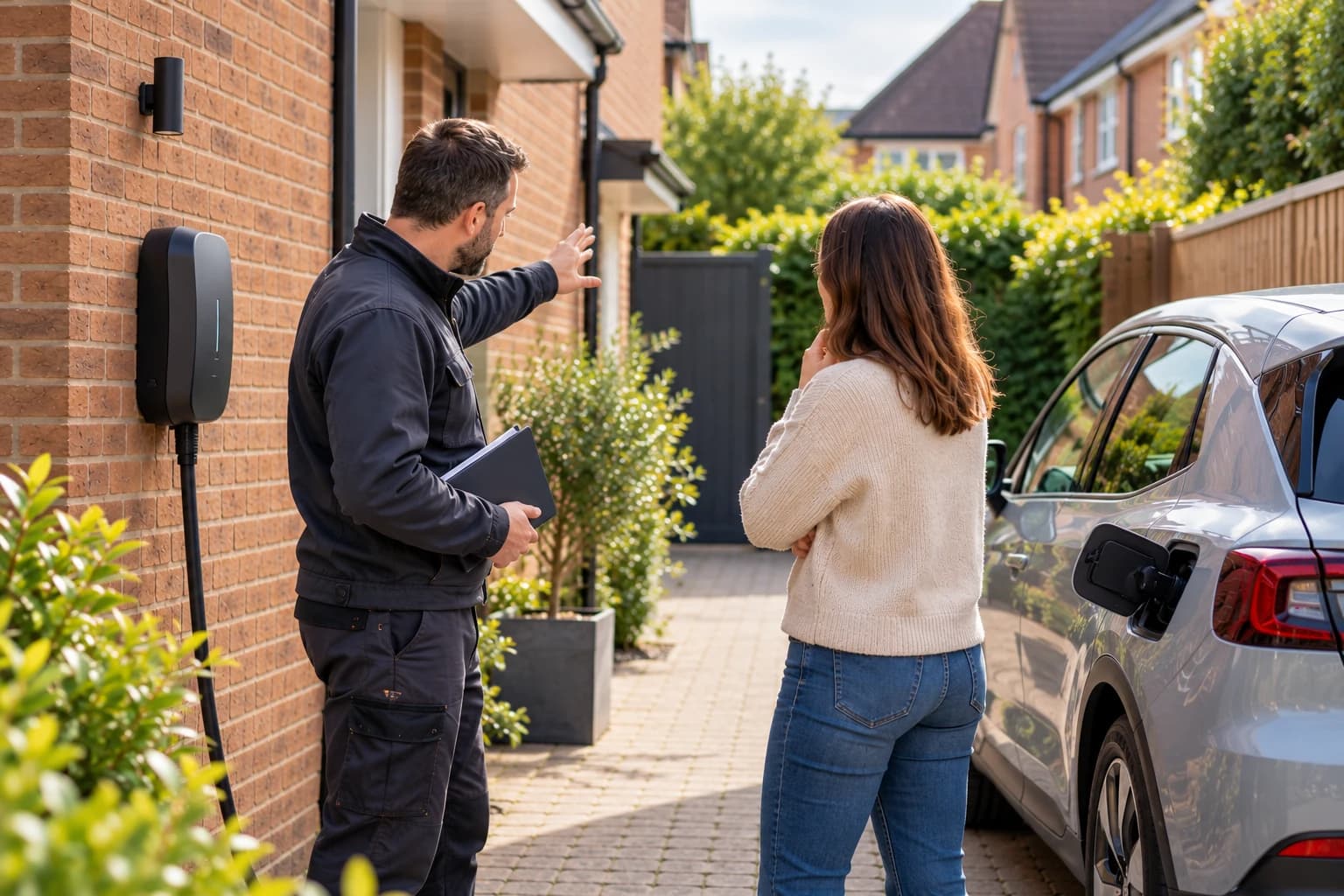
Give installers the same parking position and preferred charger location. A short accessible wall route and a route crossing a driveway involve different work. Discuss distance, wall penetrations, posts, trenching and reinstatement. A quote that includes digging but leaves repairing the surface to you is not an all-in finished price.
The electrical survey should also establish the available capacity and suitable circuit arrangements. Work around the consumer unit, monitoring for load management or changes to existing equipment can alter the scope. Do not assume that a new consumer unit or a particular protective device is necessary just because it appears on another person’s invoice.
Ask the installer to explain any proposed extra work in plain English, including whether it is needed for this installation or is a separate improvement. Our installation overview helps you prepare consistent information for those discussions.
In plain English
Separate network work from the installer package
The distribution network operator owns the network supplying the property. Some installations can proceed through the relevant notification process; others need further assessment or supply work before connection. The electrician should establish which applies.
UK Power Networks says there is no charge payable to it where the installer can complete the job without a supply upgrade. It also says it cannot give a universal online price or timeframe for required upgrade work, because the work and permissions vary. That statement concerns its network service, not free installation of the charger.
If your property is outside that operator’s area, check your own DNO’s arrangements. Request written clarification of who applies, who pays, and whether any network quote is included. A retail charger package should not be taken as a promise that all third-party supply work has been covered.
In plain English
Check today's grant terms before starting work
As of this guide’s review date, OZEV’s April 2026 changes increased the maximum award for the specified home schemes to £500 per socket. The available schemes include flats and renters, residential landlords and qualifying households with on-street parking. This is not a discount automatically available to every homeowner.
Check the current scheme for your tenure, parking arrangement and vehicle. The on-street scheme, for example, has specific conditions around a qualifying cross-pavement solution and highways permission. Costs associated with that arrangement need their own clear quote; do not assume every related item is eligible for support.
The current household guidance says not to have the chargepoint installed before eligibility notification from OZEV where applying for the relevant grant. Verify that timing before booking work. Old adverts may show previous awards or closed schemes, so use the live government guidance rather than treating an installer banner as confirmation.
In plain English
Compare like-for-like written proposals
Send each installer the same photographs, route description, car details and information about future household demand. Ask whether a remote survey is enough or whether an on-site visit is needed. Agree how an unexpected discovery would be explained and priced before work continues.
- Exact charger model, version and cable arrangement.
- Cable length, route, groundwork and reinstatement.
- Electrical work and any load-management equipment.
- Network work, permissions and who handles them.
- Testing, setup, handover, warranty and applicable VAT.
- Exclusions, cancellation terms and how variations are approved.
Electrical Safety First recommends competent, registered installation. Treat competence and the completed scope as part of the comparison, not just the lowest number. If one proposal differs significantly, ask which item explains the difference before drawing conclusions.
Your next step
What this means for your budget
Keep installation spending separate from the cost of each future charge. A tariff saving does not tell you what the installation will cost, and a cheap fitting quote does not tell you the price of electricity afterwards. Use the charging-cost calculator for that separate calculation.
Keep the confirmed price, any grant awaiting approval and work that still needs pricing separate in your budget. Do not count an unapproved grant as money already available. Ask for an updated written quote if the location, charger or electricity supply arrangement changes.
Compare charger specifications before asking for quotes. Ask installers to price the cable route and electrical work for your property so you can compare complete installation costs.
Further reading
Sources
- Last reviewed
- zappi product information — myenergi. Single/three-phase zappi versions, renewable charging modes and advertised hardware pricing checked on 1 October 2026. Installation costs are separate.
- Electric vehicles: cost, time and what's involved — UK Power Networks. Supply assessment, installer notification and site-specific network work. UK Power Networks' process applies in its own service area; other operators have their own arrangements.
- Changes to chargepoint grant schemes from 1 April 2026 — Office for Zero Emission Vehicles, GOV.UK. Current schemes, maximum awards and the requirement to await eligibility notification before installation where claiming the specified household grants.
- Chargepoint grant for households with on-street parking — Office for Zero Emission Vehicles, GOV.UK Find a grant. Cross-pavement permissions, non-temporary solutions, eligibility, and the explicit warning that the scheme does not reserve a parking space.
- Electrical safety advice for electric vehicles — Electrical Safety First. Dedicated charging equipment, competent installation and stopping use of damaged charging cables.