Guide
What size cable does a home EV charger need?
There is no universal cable size for every home charger. The installer must design the cable for the charging demand, complete route, installation conditions and protection. A cable size copied from another household, or chosen only from the charger power, is not a design for your property.
In plain English
First say which cable you mean
The fixed supply cable connects the household electrical installation to the charger. The charging lead connects the charger to the car. A tethered unit has that lead attached; an untethered unit uses a separate lead.
Those cables have different jobs and selection requirements. A suitable vehicle lead does not establish whether the fixed supply cable is adequate. Likewise, a large supply cable cannot make an unsuitable vehicle lead correct. Tell the installer which part you are asking about.
Cable sizes are often expressed in square millimetres, describing the cross-sectional area of a conductor, not simply the thickness of the outer cable. That number alone does not identify the cable construction, permitted installation conditions or protective arrangement. Do not buy cable from a photograph or a remembered number.
In plain English
The intended charging demand starts the design
The designer needs the charger version, its intended operating rate and the supply arrangement. Single-phase and three-phase equipment are not interchangeable just because they share a model name. A car’s present AC limit is also not a complete specification for wiring that may later supply another vehicle.
Discuss any fixed limit or load-management system that forms part of the proposal. It must be accounted for and commissioned properly; it is not enough to say you will usually charge slowly. Do not plan to increase the power later without checking whether the finished installation supports that change.
Our supply-type guide explains the broad difference. The electrician should turn those requirements into a design, including the protection and manufacturer instructions, rather than asking you to select the components.
In plain English
Length and installation conditions change the answer
A route through insulated building fabric, a route exposed to the weather and a buried or contained route are not automatically equivalent. The cable must suit its environment and have the required protection against damage. How easily it can release heat is part of the assessment.
The IET’s July 2026 discussion of pavement cable channels explains how temperature and confinement can change current-carrying capacity. Its detailed example tables relate to particular cable and channel assumptions. They should not be copied as a general answer for a fixed home-charger supply.
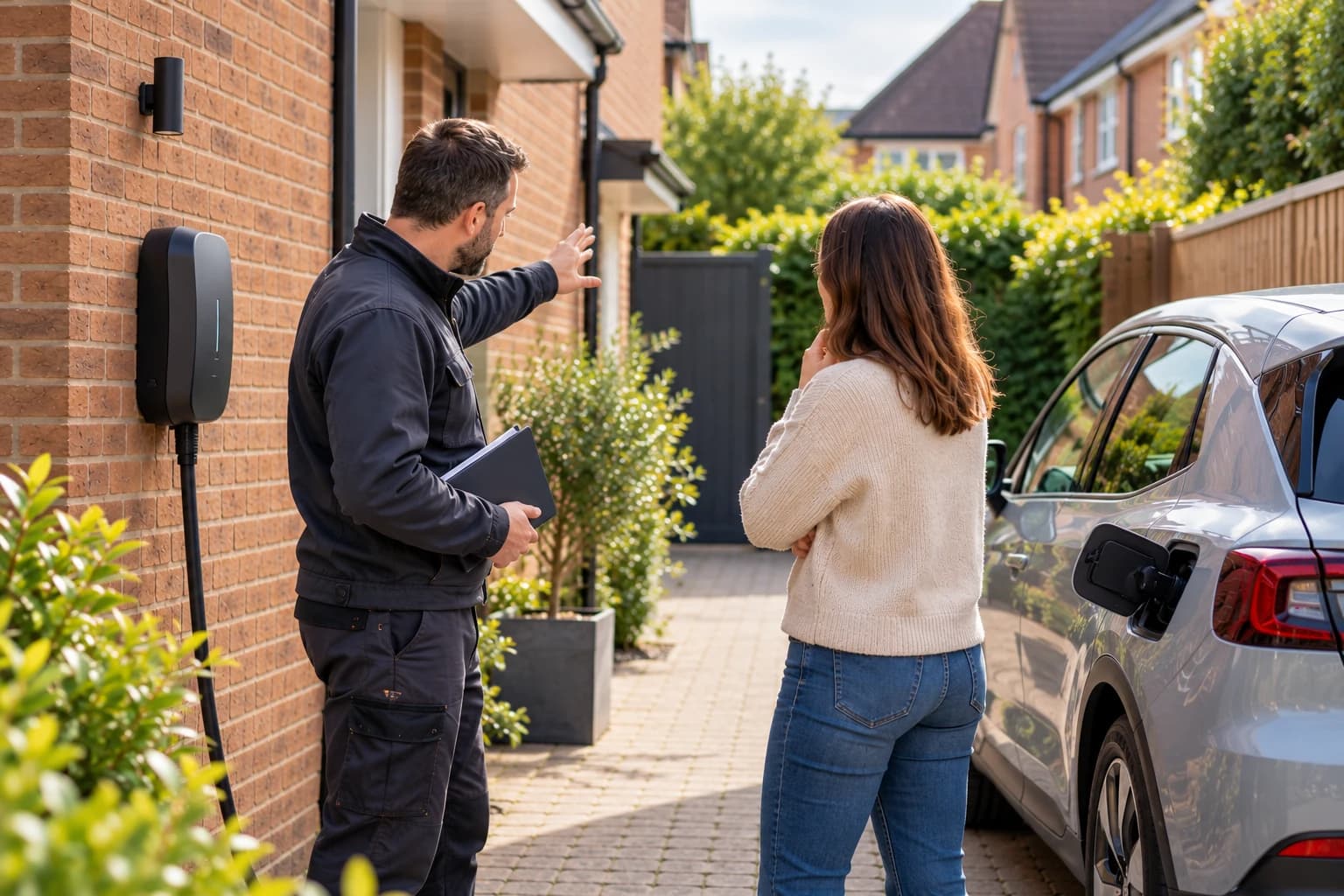
Give the installer the whole route, including awkward sections, not just the straight-line distance from the consumer unit to the driveway. Grouping with other cables, crossings and proposed future landscaping are relevant information for the design. If the route changes, the original specification may need to be revisited.
In plain English
Voltage drop is another check, not a charger fault diagnosis
Voltage drop is the reduction in voltage along a cable while current is flowing. The IET explains that cable length and current affect it, and that an installer calculates the supply-cable arrangement to deliver an appropriate voltage.
The charging lead also forms part of the route to the vehicle. A long lead is not automatically equivalent to a short one, and an extension should not be assumed acceptable. Use the cable specified or approved for the charging equipment and vehicle.
This does not mean any slow session proves the supply cable is undersized. Car limits, schedules and load balancing can also reduce the rate. Use the slow-charging checklist to record the symptoms, then have the installer investigate rather than replacing cable on a guess.
In plain English
Cable, protection and connections belong together
The cable and protective devices must be selected as a coordinated installation. Choosing a larger breaker because the charger seems slow can remove the protection intended for the wiring. Choosing a larger cable does not, by itself, settle earthing, isolation or the condition of the connections.
The IET’s public guidance distinguishes protective, isolation and switching functions. These are design questions for a competent installer. A consumer guide should not turn a single charger power figure into a universal breaker rating or a do-it-yourself wiring diagram.
Future-proofing needs the same care. Ask what a proposed extra allowance actually supports: another charger, a different power setting or simply an easier future route. A promise of being “future-proof” is not useful if it does not state the conditions and further work that may still be required.
Your next step
What this means for your quote
- Confirm the exact charger and operating limit the installation is designed for.
- Agree the full cable route and any groundwork or reinstatement.
- Ask the installer to explain the specified cable and protection without selecting them yourself.
- Keep the design and test documentation with the installation paperwork.
- Have any later route or charging-power change reassessed.
Read the installation-cost guide to compare the scope of proposals. The correct question is “does this design suit my installation?”, not “which cable number do most people buy?”.
Further reading
Sources
- Last reviewed
- EV charging design considerations for pavement cable channels — Institution of Engineering and Technology, Wiring Matters, July 2026. Current-carrying capacity, temperature, voltage drop and route assessment. Example tables use specific cable and channel conditions.
- Protective, isolation and switching devices explained — Institution of Engineering and Technology, Wiring Matters, July 2026. Dedicated Mode 3 charging circuits, different protective-device functions and the need for installation-specific selection. Not a universal consumer-unit or breaker specification.
- Electrical safety advice for electric vehicles — Electrical Safety First. Dedicated charging equipment, competent installation and stopping use of damaged charging cables.
- Electric vehicles: cost, time and what's involved — UK Power Networks. Supply assessment, installer notification and site-specific network work. UK Power Networks' process applies in its own service area; other operators have their own arrangements.