Guide
Why is my EV charging slower than expected?
Usually, one part of the system is setting a lower limit than the charger label suggests, or charging is waiting for a schedule. Check the car's AC limit, the charging settings and any load management first. A change from your normal behaviour deserves investigation, especially if there are fault warnings or damage.
In plain English
Check what number you are comparing
Power, measured in kW, tells you the rate at which energy is flowing. Energy, measured in kWh, tells you how much has been delivered. A display saying 7 kWh is not saying that the car is charging at 7 kW. Check the label and measurement period in the app.
Also distinguish active charging time from time plugged in. A four-hour session containing a two-hour scheduled pause will have a lower average rate across the whole period, even if the charger works normally while charging. A snapshot of the current rate tells you something different again.
Compare your own sessions under similar conditions. Record the starting percentage, target, actual charging period and reported energy. That is more useful than comparing your result with a manufacturer’s fastest published charging example, which may use a different charger and starting charge level.
In plain English
The car may be the normal limiting factor
Home chargers generally supply AC. The car’s onboard charger converts that to DC for the battery and has its own limit. The much larger DC number in a car advertisement is not a promise about charging from a home wall unit.
A car accepting at most 7.4 kW AC cannot draw 22 kW from a 22 kW unit. A car with an 11 kW AC limit cannot draw 22 kW either. The supply and charger also need the relevant phase arrangement. As one manufacturer’s example, myenergi distinguishes single-phase and three-phase zappi versions and qualifies their maximum rates as vehicle dependent.
Check the specification for your exact vehicle version, including any onboard-charger option. Our compatibility page explains the different limits. A replacement wall unit will not solve a limit inside the car.
In plain English
Look for waiting, reduced-power and solar modes
Check the car, charger and any tariff service for active schedules. Two schedules can overlap badly: the charger may be ready when the car is waiting, or vice versa. Ask which system is supposed to control the session, rather than changing everything at once.
Great Britain’s guidance for covered smart chargepoints includes preset off-peak hours and a randomised delay. A delayed start can therefore be a setting rather than a fault. Read the status message and the product instructions before repeatedly unplugging it.
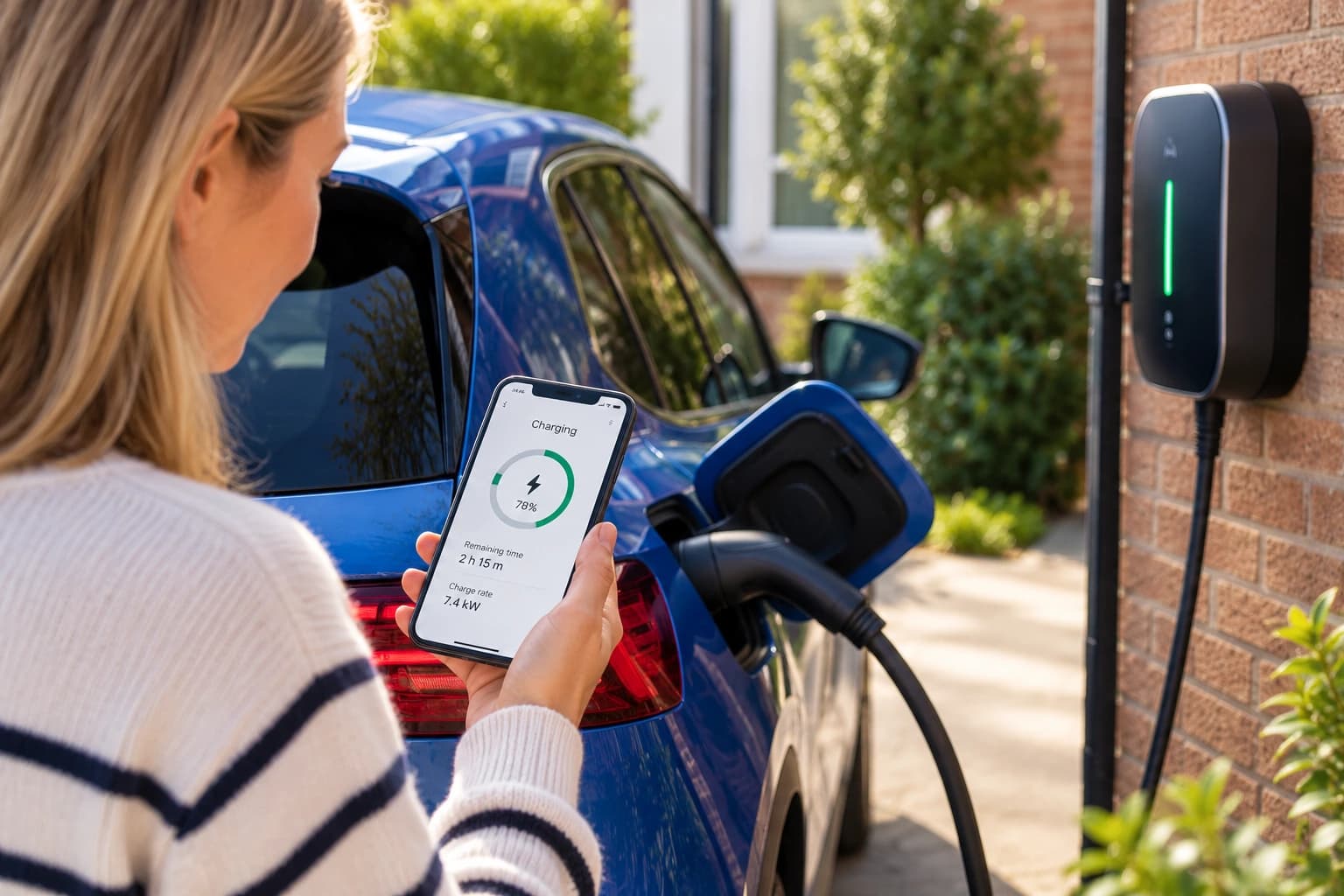
Solar-following modes may vary charging as spare generation changes. A fixed reduced-power setting may also be intentional. Separately, a poor internet connection can affect what the app reports. Do not assume that an offline app proves electricity has stopped flowing; the GB guidance includes continued charging when a covered chargepoint loses its communications connection.
In plain English
Load management can slow a session on purpose
If the charger shares available capacity with the house, its rate may fall when other appliances are running. With two EVs, the charging allowance may also be shared. Note whether slower charging coincides with heating, cooking or another car connecting.
For myenergi equipment, its Grid CT documentation explains how monitoring and Grid Limit settings can curtail charging demand. That is a manufacturer-specific mechanism, not proof that every slow session has the same cause. A missing or unreliable sensor reading is something for the installer to assess.
Do not raise a commissioned supply limit or bypass load management to test whether the charger gets faster. Tell the installer what you observed and ask whether the rate matches the agreed configuration. Our load-balancing guide explains what to ask.
In plain English
Battery conditions and energy use change the result
The car controls charging to suit its battery. Temperature management, battery conditions and the approach to a high charge level can affect the rate or energy available to store. The exact behaviour depends on the vehicle; do not apply another model’s charging curve to yours.
ADAC’s charging research distinguishes energy stored from energy used by conversion and vehicle systems. Its test conditions also separate temperature effects and end-of-charge balancing from ordinary charging losses. This is why a simple battery-size calculation is a useful estimate rather than a stopwatch prediction.
Try the time calculator with your current and target percentages and the realistic AC limit. If the gap persists across comparable sessions, keep screenshots and ask the car manufacturer or installer which part of the system is limiting the rate.
Your next step
Know when to stop checking and ask for help
Electrical Safety First says to stop using a damaged charging cable. Treat visible damage, burning smells, repeated protective-device trips or a persistent fault message as reasons to seek competent help, not reasons to increase a setting or improvise a different connection. Do not open the charger or supply equipment.
- Save the error message and time it occurred.
- Note the car, charger, charge level and active modes.
- Explain whether this has always happened or started recently.
- Tell support about recent installation, tariff or software changes.
The aim is to identify a cause safely. Slower-than-advertised charging can be entirely expected; unexpectedly changing or faulting charging needs a different response.
Further reading
Sources
- Last reviewed
- zappi product information — myenergi. Single/three-phase zappi versions, renewable charging modes and advertised hardware pricing checked on 1 October 2026. Installation costs are separate.
- Regulations: electric vehicle smart charge points — GOV.UK / Office for Product Safety and Standards. Great Britain rules for covered private chargepoints, including default off-peak settings, randomised delay and continued charging without a communications connection.
- The critical role of Grid CT sensors in myenergi installations — myenergi. Manufacturer-specific explanation of supply monitoring, Grid Limit settings and charger load curtailment; not a universal specification for other brands.
- Charging losses in electric cars: ADAC measurement study — ADAC Technik Zentrum. German research on AC conversion, vehicle auxiliary loads and measurement boundaries. Results depend on the tested cars and conditions; UK electrical requirements differ.
- Electrical safety advice for electric vehicles — Electrical Safety First. Dedicated charging equipment, competent installation and stopping use of damaged charging cables.