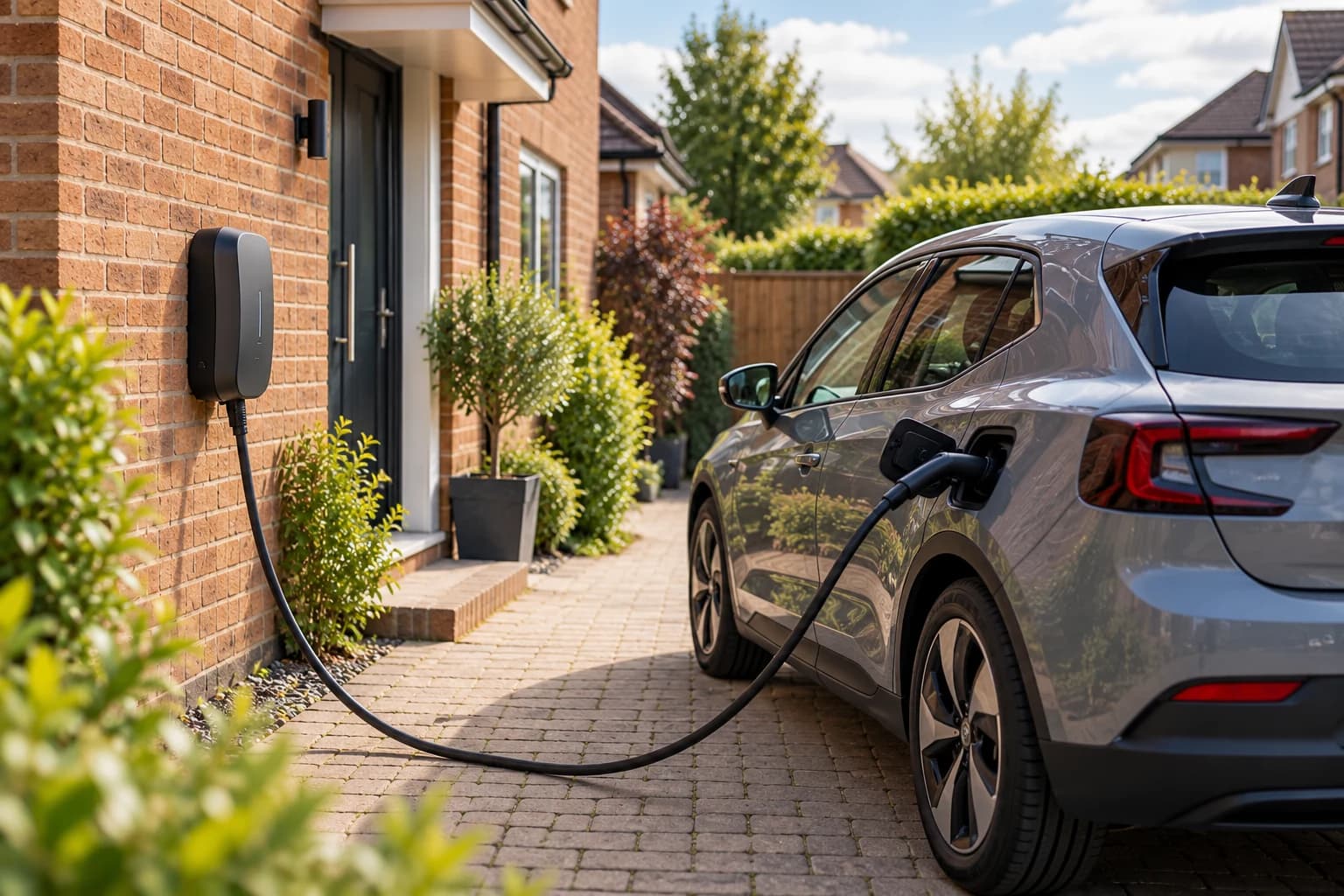
Choose in this order: what your supply and car can actually do, whether you can claim a grant and the model is on its list, tethered or untethered, then the features. Buying the other way round, features first, is how people end up paying for speed and apps they cannot use.
The order
Five decisions, in the right sequence
Each one narrows the list for the next. Doing them out of order wastes money and time.
01
Before you start
What can my car and supply actually do?
Have your home's supply assessed and check your exact car's maximum AC charging rate. Choose power that suits your charging window; a larger number on the charger is not a guarantee of a faster charge.
02
Second
Am I entitled to a grant, and is the model on the list?
The current schemes do not cover every household. A flat owner or a renter with private off-street parking can apply, and so can a household relying on on-street parking using a cross-pavement solution. An owner-occupier in a house with a driveway cannot. If a grant is available to you, both the model and the installer must be eligible, and the order is strict.
03
Third
Tethered or untethered?
A decision about daily convenience and where the cable lives, not about speed. If you have two electric cars, or the cable would have to cross an awkward distance, this may decide it for you.
04
Fourth
What do the smart features actually do for me?
Scheduling is the one that usually pays for itself, because it lets charging happen during a cheaper tariff. Load management matters if your supply is tight. Solar diversion is only worth paying for if you have solar panels, or plan to.
05
Last
What will installation cost at my house?
The charger is the smaller half of the invoice. Cable length, groundwork, consumer unit work and the earthing arrangement set the rest, and they vary enormously between homes. Get quotes that itemise these rather than a single number.
The grant
Check grant eligibility before you fall in love with a model
This is the step most people miss, and it can invalidate the whole purchase.
The government runs several chargepoint grant schemes through the Office for Zero Emission Vehicles. As reviewed on 30 September 2026, the maximum grant available to households and landlords is £500 per socket, and funding for the current schemes runs until 31 March 2027. These figures can change, so check the GOV.UK pages before you rely on them.
Who the current home schemes are for
Two home schemes are open, and neither covers the case many people assume. The flats and renters grant is for people who own and live in a flat, or who rent any residential property, and who have a private off-street parking space. The households with on-street parking grant is for people who only have on-street parking and are installing a cross-pavement solution such as a charging gully.
The important exclusion: if you own and live in a house, the flats and renters grant does not apply to you. So a homeowner with a driveway, which is the most straightforward case, cannot currently claim it. If that is your situation, budget for the full installation cost.
Also check your car is on the approved list
The grant is tied to both ends. Your vehicle must be on the OZEV list of approved electric vehicles, and the chargepoint must be an eligible model. The same list is a useful reference in its own right, because it records charging details for each approved vehicle, including the maximum alternating-current rate.
Features
What the extra features actually do
Worth paying for one or two of these. Not worth paying for all of them.
Once speed, grant and cable are settled, the remaining choice is features. The useful way to think about them is what problem each one solves for you specifically.
Scheduling
Start and stop charging at set times
The feature with the clearest financial benefit, because it lets you put charging in a cheap tariff window. Check how scheduling works: whether it is a timer you set yourself, whether it can pull prices from your supplier automatically, and what happens if your internet connection drops mid-schedule.
Load management
Slows charging when the house needs power
Also called dynamic load management. The charger watches what else your home is drawing and reduces its own demand, so charging and the oven can happen at once. Worth having if your supply is close to its limit, or if you are near the threshold where the network operator needs to be involved.
Solar modes
Uses your own generation
Charges preferentially from solar panels, sometimes by holding back and releasing power later in the day. Only worth paying a premium for if you have panels, because without them the mode does nothing.
Remote information
Seeing what your charger did
A record of sessions, energy added and cost, viewed in an app. Genuinely useful for checking your figures, but it is reporting rather than saving, so it should not be the main reason to choose a model.
Tariff integration
Pulling cheap rates automatically
Some chargers connect to your supplier to charge at the cheapest time without you setting anything. The catch is that it may need a particular meter or a broadband connection, and the list of supported suppliers changes. Check your supplier is supported before buying.
One warning about smart features in general: some need a particular meter type, a particular energy supplier, a stable broadband connection or compatible solar inverter. A car that charges successfully is no proof that every extra feature will work at your home. Ask specifically what each feature requires.
The installer
Questions to ask every installer
Ask each installer these questions so you can compare what is included in their quotes.
Quote descriptions are hard to compare because they omit different things. Asking the same specific questions of every installer makes the differences visible.
1
Is this model on the current OZEV list of eligible chargepoints, and is the grant available for a household like mine?
2
Are you an OZEV-authorised installer, and will you submit the grant claim for me?
3
What certificate will I get for the electrical work, and which scheme or body issues it?
4
Will you notify my distribution network operator, and can I have written confirmation when you have?
5
Is the quote inclusive of cable, protective devices, any consumer unit work and reinstatement after digging?
6
Where exactly will the unit go, and what cable length does that need?
7
What is the total price, and what happens to it if the survey finds something unexpected?
8
What warranty does the manufacturer offer, and who administers it?
If an installer cannot answer the first two, that is a useful signal. If they will not tell you where the unit will go or what certificate you will receive, the price is not comparable with anyone else's.
What this means for you
Before you choose a charger
None of this requires expertise. It requires a sequence. The first two checks are free, and either of them can rule out a product you have already decided you like, which is exactly why they come first.
Confirm the phase arrangement of your supply and your car's maximum alternating-current rate. If either is a single phase, your decision is made.
Check the grant before you shortlist. If your household is not covered, the installer question drops away and the cost comparison becomes straightforward.
Get two or three itemised quotes. Installation cost varies far more between homes than charger price varies between products, so the charger is rarely where the money is.
Two other guides cover the parts most worth reading in full. How a home charger is installed covers what the installer does and the network notification that follows, and what a charge actually costs is the calculation that decides whether scheduling is worth paying extra for.
Charging electric vehicles— Energy Saving Trust. Consumer guidance on chargepoint power levels and home charging.
Your analytics cookie choice
We use optional Google Analytics cookies to understand which pages and tools people use. Analytics stays off unless you accept. Declining will not affect how the site works.
Your choice is saved for six months. You can change it using “Analytics cookies”. Google receives usage information only after you accept; we do not send your calculator entries, names or email addresses. Google's privacy policy.