Guide
What is a Type 2 EV charger connector?
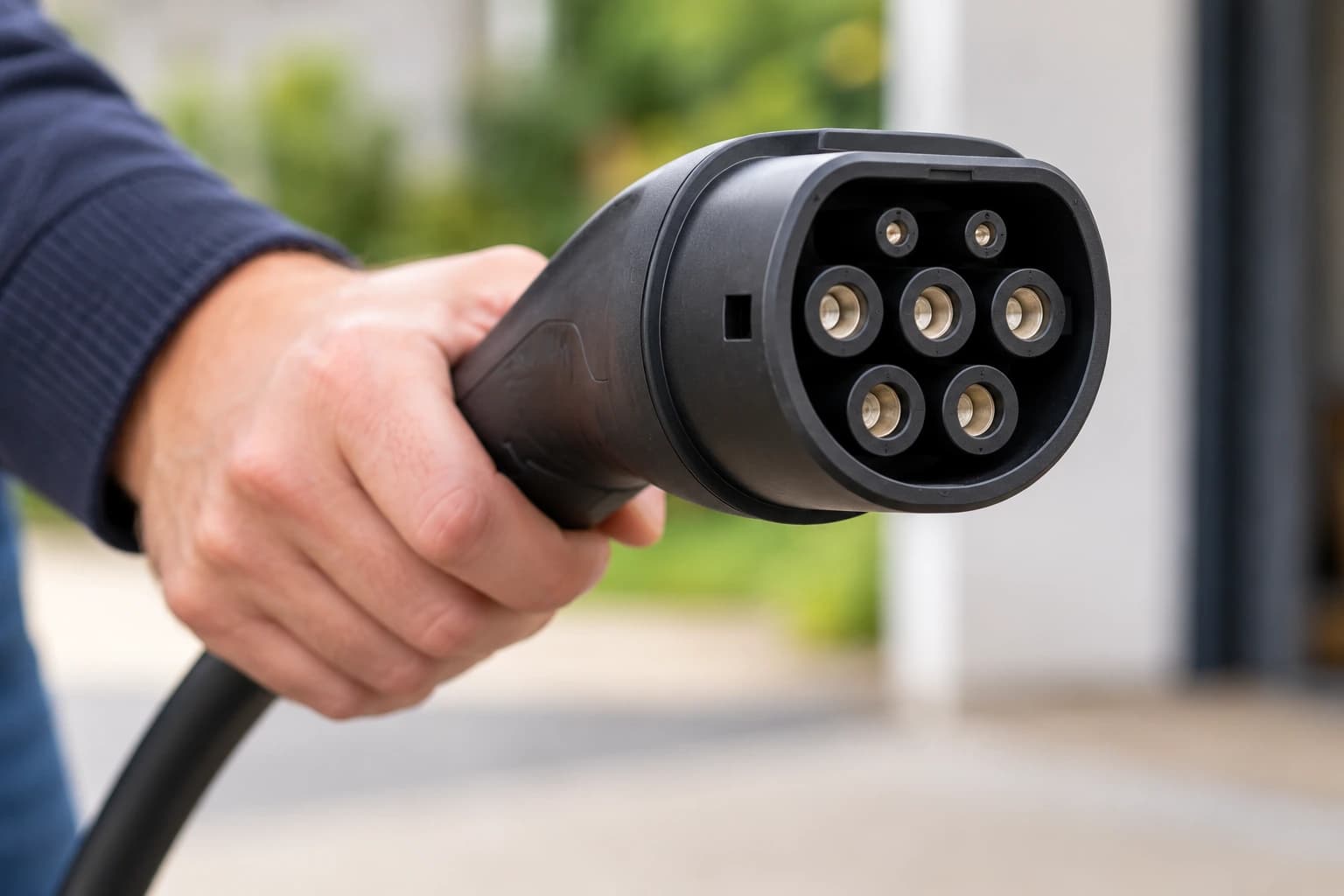
Type 2 is the round plug used to charge an electric car from a home wall unit, and from most public chargepoints that supply alternating current. Nearly every electric car sold in the UK uses it, which is why it is rarely the thing that decides which charger you can buy.
What it is
Type 2 in one paragraph
A standard, not a brand. That is the important part.
Type 2 is a connector design defined in an international standard, published as IEC 62196-2 (BS EN 62196-2 in the UK). That matters for a practical reason: because it is a standard rather than one manufacturer's product, it is widely implemented, and you are not locked into buying a cable from whoever made your charger.
It is also sometimes called the Mennekes connector, after the company that promoted it. That is an alternative name for the same design, not a different plug.
Government guidance on chargepoint specifications for the chargepoint grants requires installations to be carried out to BS EN 61851, which is the standard family that includes this connector. So a Type 2 home installation is not an informal choice. It is the mainstream one.
AC or DC
Why home charging uses a different plug from rapid charging
The distinction explains most of the confusion around connectors.
A battery stores direct current, not alternating current. Mains electricity is alternating current. Something has to convert between the two.
At home, the conversion happens inside your car. The wall unit supplies alternating current through a Type 2 connector, and the car's onboard charger converts it. The car is doing the hard part, which is why home charging is slower than it might appear, and why the car rather than the charger sets the maximum rate.
On a public rapid charger, the equipment does the conversion instead, supplying large amounts of direct current. That needs heavier cables and a much larger connector, and most cars have a separate inlet for it. This is the practical difference: home charging is alternating current through a Type 2 connector, public rapid charging is direct current through a different one.
The parts
Four things that get called the connector
People use the word for several parts of the system, which makes conversations harder than they need to be.
When a supplier or installer says Type 2, they may mean the plug, the socket in the car, or the whole cable assembly. These are the four separate parts:
- Inlet
- The socket-shaped hole in the car. It is a fixed part of the vehicle and the thing your cable plugs into. Many cars have one inlet for home charging and a separate, larger one for rapid charging.
- Connector
- The plug at the end of the cable. On a tethered unit it is always there; on an untethered unit it comes with your own cable.
- Wall unit
- The box fixed to your wall or post. Its outlet is a socket, and it is where the safety and control electronics live. It is often called a wallbox, though that word is used loosely.
- Cable
- The lead between the wall unit and the car. With an untethered charger you choose and own it, which means you choose its length.
This is worth keeping in mind when reading a product page. “Type 2 socket” normally describes the outlet on the wall unit, while “Type 2 cable” describes the lead. A charger advertised with a Type 2 socket still needs a cable, unless the cable is attached.
If your car and untethered chargepoint both use Type 2, you can browse separate cables at EV Cable Shop. Check the connector, current rating, phase support and length against the car and chargepoint documentation before buying.
View Type 2 charging cables* → at EV Cable Shop / EV King (opens in a new tab)Why it matters
Why it is rarely the deciding factor
Because the standard is so widely implemented, Type 2 compatibility is usually settled before you start shopping. If your car charges from a home wall unit, you already have the connector that matters, and almost any compliant home charger will work with it.
Two related points are worth knowing. First, a Type 2 connector can carry alternating current over a single phase or over three phases, and the same connector is used either way. That is why the connector alone does not tell you a charger's speed; a three-phase Type 2 connection is what allows a 22 kW rate, and a single-phase one is capped much lower.
Second, older and imported cars are the exception worth checking. Some vehicles brought into the UK from markets that use different standards may need a different connector, and very early cars used a different home charging arrangement altogether. Check the car's own documentation rather than assuming.
Confusions
Four things people get mixed up
“Type 2 and CCS are the same thing.”
They are related but they are not the same. A CCS inlet has the Type 2 shape with two extra large pins underneath for direct current. A car with CCS can still charge from a plain Type 2 wall unit, using the upper part for alternating current.
“Type 1 and Type 2 are regional choices.”
Type 1 was the earlier alternating-current connector design and is not the standard used by cars sold in the UK. It is worth knowing the name mainly so you can tell a mislabelled product page from a different market's equipment.
“A Type 2 charger is a wallbox.”
The two words get used interchangeably on shop pages, but they describe different things. Type 2 is the connector standard. A wallbox, or home chargepoint, is the installed box. A home chargepoint uses a Type 2 connector, so the confusion is understandable, but it is worth separating them when you read a specification.
“It has a Type 2 socket, so it will be fast.”
The connector says nothing about speed. Speed comes from the charger's rated power, the number of phases your home has, and your car's onboard charger. That is explained in the 7 kW and 22 kW guide.
What this means for you
Check the connection before buying
If you are choosing a home charger, the connector is one of the few parts of the decision you can set aside. Confirm your car uses Type 2 for home charging, then focus on the things that actually differ between products.
- Look for a Type 2 socket and decide separately whether you want the cable attached, since that choice affects daily use rather than compatibility.
- Measure the distance from your consumer unit to the car's inlet before choosing a cable length, and give that number to your installer.
- Do not read anything into a Type 2 label on a rapid charger. Rapid chargers use CCS, and the Type 2 part of it is the alternating current fallback for when a car cannot take direct current.
Speed is the next decision, and it is mostly about your house and your car rather than the plug. How 7 kW and 22 kW compare sets that out, and how to choose a home EV charger walks through the whole sequence in the order that saves money.
Further reading
Sources
- Last reviewed
- Electric vehicle chargepoint and infrastructure specifications — Office for Zero Emission Vehicles, GOV.UK. Sets out the standards chargepoints and their connectors must meet, referencing BS EN 61851.
- Charging electric vehicles — Energy Saving Trust. Consumer guidance on the different kinds of charging and their speeds.
- Electric vehicle chargepoint grant for renters or flat owners: Eligibility — Office for Zero Emission Vehicles, GOV.UK. The OZEV list of eligible vehicles records charging details for each approved model.
- Will a home charger work with your car? — EV Charger Help. Why a matching plug does not settle the whole question.
* Affiliate link: If you buy through a marked link, EV Charger Help may receive a commission. This doesn't affect what we recommend.