Guide
Home charging vs public charging: what is the difference?
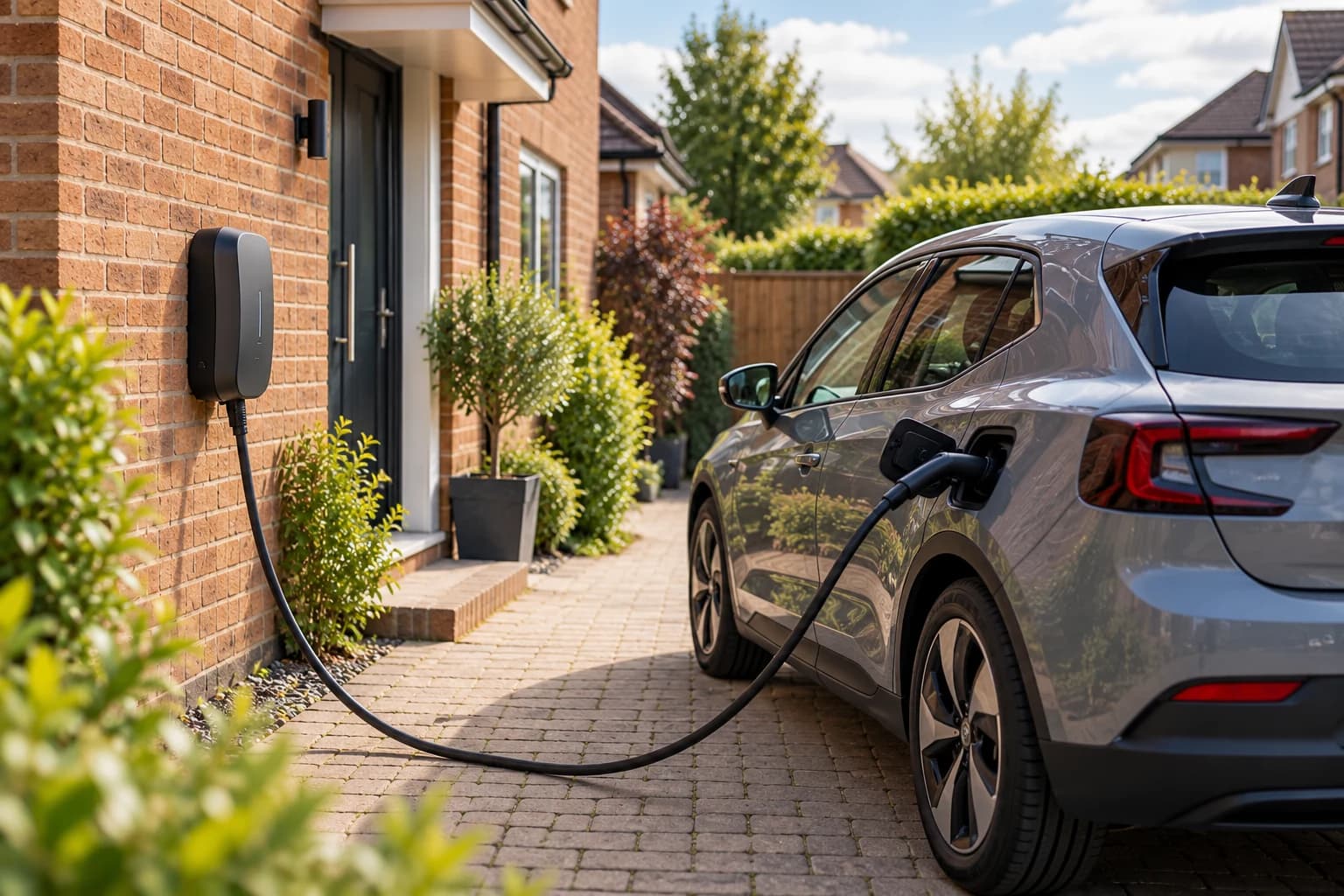
Home charging gives you an assessed connection where you park and a household electricity tariff. Public charging adds operator prices, access and parking rules, and may use AC or rapid DC. Neither location guarantees one speed or cost: compare the charging type, your car’s limits and the complete session.
In plain English
Location and charging type are different questions
A home wall charger normally supplies alternating current, or AC, which the vehicle converts for its battery. Public charging includes AC units as well as direct-current, or DC, rapid chargers. A charger being public does not automatically make it faster than a home unit.
AC charging is limited by the car’s onboard charger as well as the unit and supply. DC charging uses a separate supported connection and is governed by the vehicle’s DC capability and charging conditions. A large advertised DC number should not be used to estimate a home AC session.
Renault’s cited owner manual distinguishes AC and DC connections and describes variations by vehicle version. Use the equivalent instructions for your own car. Our compatibility guide explains why a suitable connector and a headline power rating are only part of the answer.
In plain English
Compare the time the car already spends parked
At home, a long parking window can make a lower-power charge practical without a special journey. But that relies on suitable parking and an assessed installation. If you do not have reliable access to a space, the convenience changes.
Public AC can fit a workplace visit, shopping or another destination where the car is parked anyway. Rapid DC may suit a journey stop or a larger top-up when you have less time. The useful comparison is whether a location fits your routine, not whether one charging category always wins.
For shared spaces, check opening hours and the actual right to park there. A charger symbol on a map is not a reserved bay or a guarantee that the unit is working. Keep an alternative nearby if the location matters to your onward journey.
In plain English
Compare the total charge, not a universal price claim
At home, the session calculation depends on the electricity you import and the tariff applying while you charge. A time-of-use rate may change during the session. Solar or household storage can change the energy source, but does not make all equipment and energy costs disappear.
For public charging, use the operator’s current price for that location and payment method. GOV.UK’s public-chargepoint guidance requires clear pricing in pence per kilowatt hour for covered charging sessions. Also check parking charges, overstay conditions and any subscription or access terms.
As a purely assumed comparison, 30 kWh at 25p costs £7.50, while 30 kWh at 60p costs £18, before any separate charges. These are arithmetic examples, not current UK average home or public rates. A reliable comparison uses your actual tariff, the operator quote and comparable measurement boundaries.
In plain English
Payment and parking can matter as much as power
Check how a public unit is started: an app, payment card, operator account or another supported method. The UK public-chargepoint rules include contactless requirements for certain types of unit, not a blanket promise that every public socket accepts a bank card.
Make sure you have the cable the location requires. Some units provide a charging lead and some require your own. Check the operator and vehicle instructions before travelling rather than assuming all AC bays or all connectors work the same way.
Read the parking rules independently of the charging tariff. Permission to charge does not necessarily extend a parking time limit. Save the session confirmation and use the operator’s support channel if charging fails; the regulations include a free, staffed support helpline for covered operators.
In plain English
Headline power is not the battery’s energy gain
Charging power can change during a session. Battery temperature, starting charge and vehicle controls affect what is possible. A rated maximum is not a promise that the same power will flow until the battery reaches the target.
Energy reported at a charger and energy gained by the battery are also different measurements. ADAC’s first-party study distinguishes conversion losses and vehicle auxiliary consumption. Do not compare a home calculation based only on battery gain with a public invoice based on charger-delivered energy and call the difference a tariff saving.
Our charging-losses article explains those boundaries. Use the time calculator for home AC planning, not to predict a rapid DC charging curve or a guaranteed departure time.
Your next step
What this means for your charging plan
- Identify the car’s AC and DC limits and suitable connectors.
- Map reliable parking windows at home and regular destinations.
- Compare actual prices, payment methods and parking conditions.
- Use equivalent energy assumptions in cost comparisons.
- Keep a backup charging location for journeys or shared bays.
If home charging is feasible, compare charger specifications before arranging a survey. If it is not, the no-driveway guide helps you assess options without relying on an improvised household connection.
A mixed routine can be practical: home charging for ordinary use and public charging when a journey or parking arrangement calls for it. The aim is dependable access and an understood total cost, not a universal claim that one location is always cheaper or better.
Further reading
Sources
- Last reviewed
- Regulations: public charge points — GOV.UK / OZEV / Office for Product Safety and Standards. UK public-chargepoint scope, clear pence-per-kWh pricing, support and payment requirements. Contactless requirements depend on the chargepoint type.
- Renault 5 E-Tech electric: charging instructions — Renault owner manual. The displayed manual edition from 26 May 2026: daily 80% advice, portable charging conditions, socket assessment and prohibitions on extension leads or adapters. Examples apply to the covered Renault, not all EVs.
- Electrical safety advice for electric vehicles — Electrical Safety First. Dedicated charging equipment, competent installation and stopping use of damaged charging cables.
- Regulations: electric vehicle smart charge points — GOV.UK / Office for Product Safety and Standards. Great Britain rules for covered private chargepoints, including default off-peak settings, randomised delay and continued charging without a communications connection.
- Charging losses in electric cars: ADAC measurement study — ADAC Technik Zentrum. German research on AC conversion, vehicle auxiliary loads and measurement boundaries. Results depend on the tested cars and conditions; UK electrical requirements differ.